



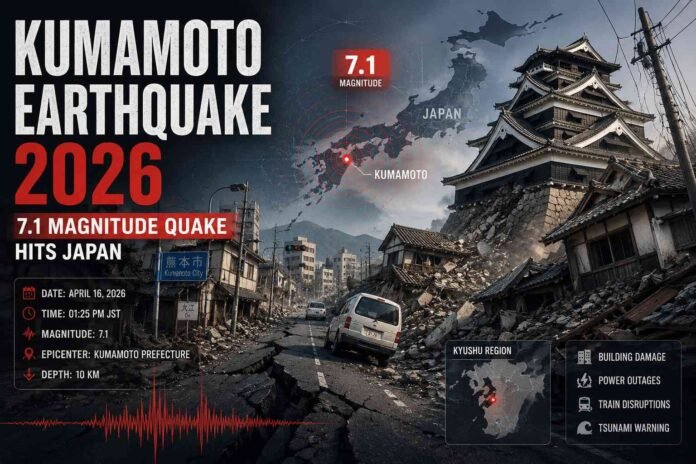
At 4:27 PM, the ground in southern Japan stopped holding still. Within seconds, homes buckled, a shopping mall lost part of its second floor, and more than 150,000 people were told to leave.
That’s the scene in Kumamoto Prefecture on Tuesday, July 28, 2026, after a magnitude-7.1 earthquake — one of the strongest to hit the region since 2016 — struck near Uki City at a shallow depth of 10 km, registering a maximum intensity of 7, the highest on Japan’s Shindo scale.
Key facts:
- At least 50 people are hospitalized, including about 10 from an elderly care facility.
- Multiple people are trapped in a partially collapsed Aeon Mall after a reported explosion.
- A tsunami advisory (waves up to 1 meter) was issued and lifted within an hour; no wider Pacific threat.
- Over 150,000 residents were ordered to evacuate; up to 48,300 households lost power during a summer heatwave.
- At least 12 homes collapsed, expressways ruptured, and Kumamoto Castle’s recently restored walls cracked again.
- Shinkansen service and Kumamoto Airport flights are suspended.
- No abnormalities were reported at nearby nuclear plants (Genkai, Ikata, Satsumasendai).
Prime Minister Sanae Takaichi confirmed injuries and deployed emergency units, while Chief Cabinet Secretary Minoru Kihara said the Self-Defence Forces, fire brigades, and coast guard are helping with rescue efforts.
The JMA has warned residents to stay alert for strong aftershocks over the next two to three days, with elevated seismic risk continuing for about a week — and a heightened landslide risk on damaged terrain.