



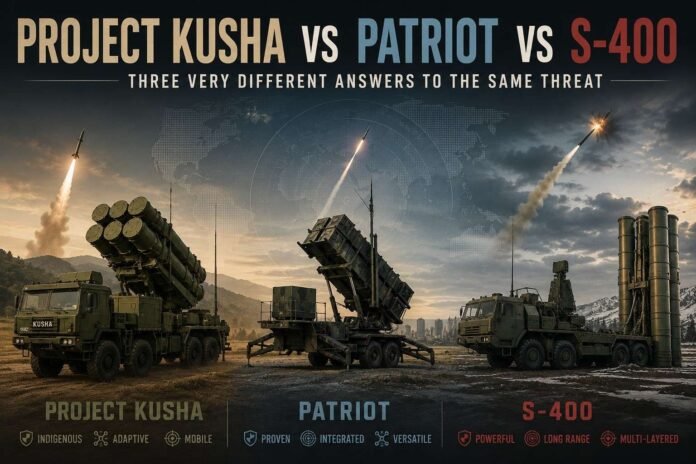
An enemy jet is 300 kilometers out. A cruise missile is skimming low. A drone swarm is inbound. Three different countries have built three very different machines to stop them — and knowing which one does what could decide who controls the sky.
That’s the real story behind the constant online comparisons of India’s Project Kusha, the American Patriot PAC-3 MSE, and Russia’s S-400 Triumf. They get lumped together as rivals because they all shoot things out of the sky. But look closer, and each one was built to solve a different problem.
Key Takeaways
- Project Kusha is India’s long-range, aerodynamic-threat interceptor — it deliberately skips ballistic missile defense, which India handles with a separate program.
- Patriot PAC-3 MSE is a shorter-range, “hit-to-kill” specialist built to physically ram incoming ballistic missiles.
- S-400 Triumf is the broadest of the three, using four different missile families to cover both aircraft and ballistic threats.
- As of mid-2026, Kusha has completed its first successful flight test but is still years from full induction — so direct performance comparisons remain partly projections, not combat-proven results.
Three Systems, Three Philosophies
Project Kusha — officially India’s Extended Range Air Defence System — had its first test flight on July 23, 2026, off the coast of Odisha. It’s being developed by the DRDO as part of India’s wider “Sudarshan Chakra” air defense umbrella, and it’s designed to complement, not replace, systems India already operates like the S-400 and Barak 8.
The Patriot PAC-3 MSE, built by Raytheon (RTX), is the workhorse of American and allied point-defense — the missile people picture when they hear “missile shield.”
The S-400 is Russia’s flagship, and the one Kusha gets compared to most, largely because both are described as reaching out toward the 400-kilometer mark.
The Comparison at a Glance
| Feature | 🇮🇳 Project Kusha | 🇺🇸 Patriot PAC-3 MSE | 🇷🇺 S-400 Triumf |
|---|---|---|---|
| Primary role | Wide-area aerodynamic interception | Point-defence / ballistic missile killer | Theater-wide, multi-layered network |
| Max range | Up to 350–400 km (M3 interceptor) | Roughly 60–120 km | Up to 400 km (40N6E missile) |
| Max altitude | Around 30–35 km | Up to 36 km | Up to 30 km |
| Guidance | Hybrid RF/IR seeker + datalink | Active radar + hit-to-kill | Semi-active/active radar homing |
| Target focus | Stealth aircraft, cruise missiles, drone swarms, AWACS | Tactical ballistic missiles, cruise missiles | Full spectrum: ballistic, cruise, aircraft |
Figures for Kusha reflect DRDO’s stated design targets as of its first 2026 flight test; final performance will depend on how trials over the next few years go.
Radar & Sensors: Why Kusha’s Timing Matters
Because Kusha is being built from scratch in the 2020s rather than adapted from early-2000s architecture, it starts with a natural generational advantage in radar and sensor processing — the same way any newer system tends to outpace an older one on paper. Reports describe Kusha’s guidance as a hybrid system combining radar frequency tracking with infrared homing, layered with a networked datalink. In theory, that combination gives it two independent ways to find a target — useful against aircraft trying to hide behind jamming or decoys, since it isn’t relying on a single sensor type.
Terminal Interception: Ramming vs. Tracking
Here’s where the Patriot and Kusha genuinely part ways in philosophy.
The Patriot PAC-3 MSE is built around “hit-to-kill” — no explosive warhead needed. It’s a very fast, very precise dart that destroys its target through the sheer force of a direct collision, which is enormously effective against a predictable, high-speed ballistic missile coming straight down.
Kusha, by contrast, appears to use a more traditional fragmentation warhead paired with a proximity fuze, but adds a dual radar-plus-infrared terminal seeker to the mix. The idea is straightforward: if an aircraft dumps chaff or jams the radar, the missile can still lock onto the target’s heat signature in the final seconds. It’s a different answer to the same problem — brute-force precision versus sensor redundancy.
What Kusha Deliberately Leaves Out
A common misconception is that Kusha is simply “India’s S-400.” It isn’t — and that’s on purpose.
The S-400 is built to catch both aircraft and heavy ballistic missiles, using an arsenal of four distinct missile types for different jobs. Kusha skips ballistic missile interception entirely. India already runs a separate, dedicated Ballistic Missile Defence program for that role, so Kusha’s engineers could focus the entire system on air-breathing threats — fighters, cruise missiles, drones, and airborne early-warning aircraft — instead of splitting its design budget across two very different missile physics problems.
One Missile Core, Three Ranges
Where the S-400 needs different missile hulls entirely to cover its short, medium, and long engagement bands, Kusha’s three interceptors — M1 (around 150 km), M2 (around 250 km), and M3 (350–400 km) — reportedly share the same core “kill vehicle,” with a bigger solid-fuel booster stage added underneath to stretch the range. If that design holds up through testing, it could meaningfully simplify manufacturing and field logistics compared to systems that require separate missile families for each range band — though independent verification of exact cost savings isn’t yet public.
FAQ
Is Project Kusha a copy of the S-400? No. While both aim for a similar maximum range, Kusha is intentionally limited to aerodynamic threats like jets, drones, and cruise missiles, and leaves ballistic missile defense to a separate Indian program.
Has Project Kusha entered service yet? Not yet. Its first flight test took place in July 2026, with full induction into the Indian Air Force expected between 2028 and 2030.
What makes the Patriot PAC-3 MSE different from Kusha and the S-400? The Patriot is shorter-range and built specifically around “hit-to-kill” technology — destroying targets through direct kinetic impact rather than an explosive warhead — making it a specialist against ballistic missiles rather than a wide-area system.
Which system has the longest range? Both Project Kusha’s M3 interceptor and the S-400’s 40N6E missile are designed to reach roughly 400 km, though Kusha’s figures are still design targets pending further testing